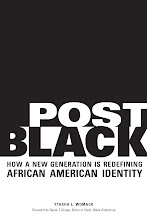
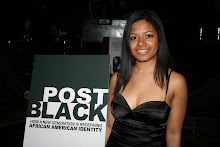
Check out the write up on Post Black in The Chicago Reader!
http://www.chicagoreader.com/chicago/ytasha-womack-post-black-african-american-identity/Content?oid=1691773
Thursday, May 6, 2010


Monday, April 5, 2010
Rock On: Interview with rockstar Jameel Lawson

YLW: How did you become a rock musician?
JL: I didn't choose to do it. It chose me. It was therapeutic. I networked and found the right people, people I could combine with musically and spiritually. I found people who weren't afraid to cross boundaries or be pidgeon holed into a certain style. I liked being with people of like consciousness where we could do a hip hop beat and turn around and do metal. I'm always growing.
YLW: Did you grow up listening to rock?
JL: I listened to ZZ Top in the 80s, Pantera, Metalica, Bob Marley, Van Halen. I grew up listening to it. It planted the seed.
YLW: But you started off doing r&b and hip hop.
JL: When I was in Good Vibes with Ben Vereen, I started off rapping and doing r&b. I still have those elements that I use. I still rap and sing but it's more aggressive. At one point I wanted to be the rapper and the r&b singer, but there was something within me that was a little more animated. I wanted to scream a little bit. The primal scream as they say.
YLW: Being African American, did people ever question your musical aspirations in rock? Did you question your ambitions?
JL: When you make a choice to embark on a new journey that most people of color don't go, it's like what am I doing? Then when you listen to the still small voice you say this could be something different. Being one of the few black rockers and one of the few notable ones is pretty flattering. It was a little frightening but anything that you do when you step out on faith, like your book, it just works out. Someone said that's a mark of a genius when you do something that the masses can't do. I thought about that. It's a blessing. It's powerful. There was a little bit of fear but I just rock on.

YLW: The term black rock is used to describe rock artists of African ancestry. What does the term black rock mean to you?
JL: In a nut shell, rock is a music of African ancestry that is now predominantly white. When I think of black rock, I think of the origin. Chuck Berry is the god father of rock and roll. Jimi Hendrix was an innovator. Living Colour pressed forward. I am a front man of a rock band with four individuals who are caucausian. I think of all those predecessors who paved the way. I look at black rock in that sense, but not where the music itself is color oriented. I don't see color in music. I don't know if other people do.
YLW: Is rock music a freer expression of music than rap?
JL: Definately. There are no boundaries at all. Your soul is free to express itself. We're not worried about what's going to get us signed. People are open minded when it comes to a rock song. People listen to the music first. Not to talk down on rap, but there's more freedom because rock is not caught up in what's hot at the time. Music needs to resonate with people. Rock music tends to have people who write music that resonates with the soul instead of with what's the hot sound. In rock and roll and even soul, certain songs don't die. Common, for example, is a hip hop artist who has a lot of songs that still resonate. It depends on the artist, it's not just the style of music. There are a lot of r&b artists and rap artists whose songs resonate.
YLW: What's your day like?
JL: I say a prayer, go to work, write a little. I practice two or three times a week. Spend time with my family. I still have a day job right now.
YLW: How do people respond when you say you sing in a rock band?
JL: Depends on who I say it to. If I'm talking to African American people, it's 'oh, that's tight, I like rock music.' Or sometimes, when I tell caucausion people, it's like “oh, really” or 'I never thought that.' Unless it's a person who really listens to that music then they know about Cody Chestnut,etc. But the one's that don't and aren't open minded are surprised that there are black rockers out there. I rarely come across someone who says “why do you do that?” We have a black president today. Being a black rock musician isn't as shocking.
YLW: Why did you join a band?
JL: I've always wanted my own band. I had an experience when I was doing my R&B rap stuff and the cd started skipping and it was so embarressing. I started rapping after the skip but at that point I had already lost the crowd. This was 2002 and I said I want a live band. There is a huge freedom because there are no boundaries. I think about Alanis Morrisette. She was a pop/r&b singer and now she's a rock artist. I still use those gifts and talents of being an r&b singer, I just do it to different music. It's louder. For people who aren't used to going to shows, I say bring your ear plugs.

YLW: Who do you admire?
JL: Chuck Berry, Living Colour, Cody Chestnut, Lenny Kravitz, Prince, Michael. It's all across the board as far as singers that I admire. James Brown, he was one of the first artists to do that primal scream and he wasn't a rock artist. Little Richard, he screamed. Marvin Gaye, Bob Marley. Jim Morrison, the Doors. Stevie Wonder, he's a genius. I can go on. But it's all a reflection . My drummers favorite band is Kiss. We all have our own influences that make up who we are.
YLW: What's it like to be a lead singer of a rock band. You're the front man. What responsibility comes with that?
JL: A caucasion guy told me once that there's something about a black rocker, where you can stand on that stage and people will look just to see. And they'll come because they know it will be really good or really bad.
YLW: Wow.
JL: Sometimes I feel my back is against the wall. It's like they're looking at me hard. I'm the only one on the bill who's the African American front man of a band. So I want to be better than everyone else. It's always a battle of the bands. You want the bands to do a good job, but I don't want to suck. No show is too small to put on a performance that is worthwhile to see again.
YLW: How did Nothing Forgotten meet?
JL: It's not like we knew one another in high school. We assembled over the Internet. We were on myspace, Craigslist. Two individuals got together and started jamming together. I saw an ad looking for a singer and I just joined. We've grown to know one another's quirks. We don't allow that creativeness to be stifled. We don't' say 'oh we can't rap because we're a rock band.' We even have a rock version of a jazz song. We don't set any boundaries. But that comes with trust and to trust the music and what's best for the particular song.
YLW: Why is it important to know about the role of African Americans in rock?
JL: It's important because I can draw upon those inspirations to continue to write great music. Some people feel we created rock and roll and abandoned it. I think it's important because it shows it's not new or alien. It's out there. It's us going back to our roots. A lot of people would disagree with that. Any form of music can have soul in it. It's all about the artist themselves.
Nothing Forgotten's music is available on Itunes.
Monday, March 22, 2010
What is Afro-Futurism?: An Interview with artist/educator D. Denenge Akpem

D. Denenge Akpem is a performance artist, designer and educator. In addition to Black Arts Movement, she is teaching a new course entitled "Afro-Futurism: Pathways to Black Liberation" at Columbia College Chicago. (Photo: D. Denenge Akpem "Super Space Riff: An Ode to Mae Jemison and Octavia Butler in VIII Stanzas" Still from performance/installation)
YLW: I think it's really interesting that you're teaching Afro-Futurism. The first time I was introduced to the concept I was in college. It wasn't called Afro-Futurism, but you had people linking liberation and art with with outer space/inner space and analyzing pop culture references in WuTang or Erykah Badu songs with Egyptology and Ayn Rand novels and Star Wars after class and in workshops. It was very intense. To know that someone is teaching it formally as an art form or way of thinking is amazing to me. What is Afro-Futurism?
DA: There are many different definitions out there, and we consider as many definitions as possible in this class. The full title of the course is "Afro-Futurism: Pathways to Black Liberation." Afro-Futurism as a topic has to do primarily with blacks in the Diaspora but also the whole of African consciousness. Afro-Futurism considers what "Blackness" and "liberation" could look like in the future, real or imagined. It is rooted in history and African cosmologies, using pieces of the past, both technological and analog, to build the future. The basic premise of this course is that the creative ability to manifest action and transformation has been essential to the survival of Blacks in the Diaspora. There are many different ways people approach the topic.
YLW: Like what?
DA: Some are very technological about the approach. Others are a lot more holistic. Mark Rockeymoore, for example, talks about the afro itself as a metaphor for Afro-Futurism, as if its very form is futuristic, reaching for new dimensions and uncontained. Alondra Nelson is one of the key theorists on the subject, and we've been looking at DJ Spooky and his Rebirth of a Nation remix, Sun Ra's music and philosophy, Octavia Butler's science fiction. We've been focused on the last century and beyond.

The approach I take is to ask: how is the envisioning of the future an act of artistic revolutionary action? We’re looking at artists who consider blackness as it might exist in the future, but also looking at artists themselves--beyond the art works--and how the actual creation of the work, the methodology is an act of or path to liberation for the artist, by the artist on behalf of the artist, communities, black people, the universe.
YLW: Can you give examples of artists who reference Afro-Futurism?
DA: We are looking at a wide range of writers and artists in music, film, visual and performing arts as well as theorists. Everyone from Labelle to Fatimah Tuggar...Pamela Z...Kodwo Eshun, so many writers and practitioners. I try to make note of the distinctions in terms of whether artists are working in ways or creating works that might be considered "Afro-Futurist" and whether the artists themselves would classify their work or themes as "Afro-Futurist." We had a similar conversation in our discussion of what is an alien, what is a human. We considered internal and external perceptions of the self and the other.
Lil Wayne talks about being an E.T. You have Outkast, ATLiens, the godfathers Afrika Bambaataa and Lee "Scratch" Perry. Sun Ra is the foundation. Parliament/Funkadelic and looking at George Clinton and the Detroit techno sound... Hattie Gossett's The Immigrant Suite: Hey, Xenophobe: Who You Callin' a Foreigner? beautifully addresses concepts of foreigner, immigrant, and contemporary xenophobia. The artistic creation of the cyborg and creating identity through these forms is an act of resistance to limitation. Afro-Futurists are saying we’re going to believe in the power of a positive future for blackness. So blackness is not limited by stereotypes of blackness. I saw a lot of parallels with the intentions of your book Post Black.
YLW: How is Futurism different from Afro-Futurism?
DA: Futurism when it developed in the early 1900s was about disavowing anything of the past. I feel that it’s a bit of a contradiction in terms to talk about "Afro-Futurism: Pathways to Black Liberation" if you're into Futurism and are defining "blackness" by the past. But that's what makes it an excellent topic for Black World Studies--that's the departmental division that this course falls under--because Afro-Futurism is absolutely rooted in the past, in race, in the use of Futurist thought and process to transcend and manipulate the facts of race in a "trickster" way, the art of dissembling and coding, and that has been part of the African Diaspora since the first abduction. It references the past in futuristic ways.
YLW: Can you give me an example?
DA: For example, key theorists and artists have discussed the concept that black people are aliens in the African Diaspora, literally. Abducted from their land, plucked up, tortured. How do you deal with that? So it’s an investigation of the alien, of hybridity. We look at the Three-Fifths Compromise, and we consider what has defined and does define "human" and what has defined human as far as black people are concerned.
The film District 9 came out last year. It’s science fiction but it’s a direct reflection of South African apartheid and draws from that history for the film's narrative, the visuals, and the concepts that are being addressed even as it provides little concrete information in the actual film or the website for the viewing public on the actual history that it references such as District 6. Perhaps the filmmaker's goal is to get people to research it further after having seen the film but the absence of some crucial links in the actual film itself might pose a problem that might take it from being progressive to another case of appropriation. I'm still thinking a lot about that film.
The question is: how do you make work that speaks to a new future? I’ve been researching Rev. A.W Nix who was a preacher who recorded gospel sermons in the 1900s. The titles themselves were interesting. "Death Might Be Your Christmas Gift.” He’s trying to push the believer to wake up. There is this "wake up people, snap out of it" conversation.
YLW: This “wake up” concept is one that we see in a lot of science fiction movies. The Matrix or Avatar come to mind, but so does Spike Lee's Do the Right Thing, too.
DA: Rev. Nix has one sermon where he references Jesus or believers meeting Jesus on a spaceship. There’s this history. It’s a fine line to straddle and people have been ostracized. Ray Charles straddled it and was ostracized until society caught up with him. Sister Rosetta Tharpe went through similar experiences with the Blues and around gender. You always run the risk of being called a cult--or occult--if you talk about aliens or other ways of understanding. The view that I take on it is that the black experience especially in the Diaspora contains within it many spiritual and scientific belief systems. It references indigenous African cosmologies that have a lot to do with other worlds and ways of knowing.
YLW: It seems as if a lot of Afro-Futurism's logic is based around the science or mythology of ancient Egypt.
DA: Sure. Sun Ra, Earth Wind and Fire, many artists were looking to Egypt. Sun Ra believed he was from Saturn, not from Earth, and that he had been picked by these other worldly beings to speak to the black folks and to minister. He was reluctant about it. He didn’t want to be the messenger even as he loved to teach and had studied to become a teacher in addition to his work as a musician in college.
Gil Scott Heron's song "Whitey on the Moon" asks why, if we can go to the moon, we can't take care of the problems and poor living conditions we have down here on Earth. "A rat done bit my sister Nell but whitey's on the moon." So I consider the subject not only from a sci-fi point of view but also look at cultural, political and social references. But there's also this concept of using technology as a basis for creative process. Wendy Walters writes about how even Motown used the auto industry as a model for their music production system.
In the end, it all provides a way to look beyond the here and now. I really credit the Humanities, History and Social Sciences Department at Columbia College for working with me on this and for seeing the connections and supporting this area of study.

YLW: How have people responded?
DA: The response has been very positive from current students in the course, from faculty with whom I get into wonderful debates about the course topics, to students who have just heard about the genre itself and are curious. "What's Afro-Futurism?" My question is: what is the history and who are the new media makers? It’s my job to guide the critical thinking process. It’s like what Amiri Baraka said, we don’t need any more of the status quo.
We've got five senses but that's just the beginning. It’s a practice that can change your life. But then again, I grew up reading Dr. Seuss. His work is not about the afro, but this books stretch the imagination into new worlds, new possibilities, very anti-xenophobia. How can the practice of creating liberate? I believe it was Maya Angelou who said if you can envision a new world, you can create it. I'm sure that's been said in other ways before, but my hope is that Afro-Futurism will help people envision a future with the goal of creative transformation for self and planet.
YLW: One issue that continues to pop up in my discussions is this notion of what exactly is blackness and does it exist. Because the notion of blackness as its usually discussed comes from a very American black liberation theory view point.
DA: I’m really interested in the idea of race, in notions of beauty and expression in culture. Obviously, the subtitle of the course is "Pathways to Black Liberation" so I am addressing Afro-Futurist works and practitioners specifically under that lens but it is not only about Black liberation. It's about liberation for all no matter what race, and liberation as it relates first and foremost to the work of the artist. No matter what the artist's intention may be, the act of being an artist, of answering that call--I take it very, very seriously. So my question is how to assist in the development of artists who are not afraid to answer that call, who are looking beyond the "norm" and who are able to enter that creative realm and come out changed but intact on the other side.
The creators have to begin to conceptualize things ahead of the society. What is race? What is post race? I feel like there’s a use for race. I feel very positively about race. I don’t hear that view a lot and this is the first time I've ever actually said that or felt that. As someone who was born and raised in Nigeria, my mother's family were Dutch immigrants to Chile and then California. She moved to Nigeria at age 25 as a nurse. My dad is a Tiv pastor whose work is rooted in service. I grew up internationally with this different perspective on race. It's not that there weren't issues but they were different in some crucial ways from the conceptions of race in this country.
Race in the U.S is immediately negative, but I feel positively about it. I don't see my duality as a struggle; it is other people that seem to have the struggle with it. But the same can be said for being black. One may love being black but when one is confronted with racism, someone else's problem become yours in the sense that it's in your sphere now and you must address it even if it's to ignore it. But the study of race is a big topic and one that I am still chewing on, still discovering... I feel that part of my study of Afro-Futurism is a way of taking back my power to define myself in a futuristic trajectory. But how is this translating into the general populace? The last story I read about race or bi-race was so negative and offensive but it was fairly recent. I think also that in terms of race we are talking about perspectives by different generations in this country. I’m interested to see how the Afro-Futurist discourse relates to all of that.

DA: Well, first, I was raised on the books of Dr. Seuss. And I specifically mention the books rather than film or animation--which I don't watch, by the way--because they shaped the foundation of my philosophy about life and art. Andrea Harrison was my professor at Smith College. She was writing plays about Einstein, producing innovative plays, climbing mountains, literally. She was my role model. She shaped my views on being a black woman and how one operates as an artist. You have to locate your thoughts and ideas within your physical body and be responsible for them. A collector I know in Chicago once said something that stays with me, that he tends to go toward the art that disturbs him or that he can't get out of his mind, that he wrestles with. In a sense, he’s saying he’s going towards the fear. That affected me profoundly, and I always find a way to share that with my students. And that’s one of the things I’m thinking about with this course. We know it’s new territory. There’s a lot of experimentation which is a big part of Afro-Futurism.
YLW: What do you say to those who argue that Afro-Futurism is just some far-out ideas by a group of oddball artists and thinkers?
DA: We need to respect the oddballs and those who are operating outside of what we call the norm. Baraka said that in his "Revolutionary Theatre" manifesto. Not that everyone has to be this freak or think George Clinton is God. It’s just about learning a methodology to go beyond the norm. I used to teach ritual performance, and the fact is that the path of the artist is one in which you’re signing up to go through a transformation. You want to teach people how to go through that process and get to the other side. Folks can get lost in that process. That's how you lose someone like a Jimi Hendrix. They’re going through that alchemic process on behalf themselves but also on behalf of us. Being an artist is a continual going through that cauldron and coming through the other side. You have to learn that process. If you don’t, you can get trapped, and you may not make it literally. I’m interested in the health of my students. I want them to thrive and tap into their greatest potential. We’re on a voyage.

YLW: You mentioned that you taught ritual performance art. Does shamanism have links to Afro-Futurism?
DA: We read text from Malidoma Patrice Somé who is Dagara from Burkina Faso. He's a shaman initiated in the ways of Dagara and also has multiple degrees from Western universities. His book Of Water and the Spirit details his initiation experience initiation. Later, he wanted to do an experiment, so he brought a videotape of Star Trek to the Dagara elders. They understood the story immediately but saw Star Trek as an example of the day to day lives of people somewhere else in the world. They saw Spock as kontomblé, one of the mystical beings part of Dagara cosmological landscape, except that he was too tall. Light speed and teleportation were completely familiar to them but they wondered why are these people wasting so much energy? We can do these things much more discretely. His point is that the West sees Africa as being so backwards but the "archaic" ways that are part of the elders' present are what the West sees as futuristic.
YLW: Afro-Futurism is a foray to explore identity as well.
DA: I want to define myself. I like categories but only as far as I can shape-shift between them. It always comes back to analog. At the end of the day you still have to connect that wire to that wire. You can get as hi-tech as you want, but it’s about the basic things. In 2002 all of my personal relationships were web based. All of my family was scattered across the planet. I was thinking about these rituals we have and how can you connect through a ritual that cares for the community, like cleansing etc. when the community is not there. This was pre-facebook. If you leave human babies alone they die or do not develop.
Biologically, we still need touch, stimulation, breathing. We haven’t evolved biologically. We’re not cyborgs yet. I worked on an interactive media piece called "Virtual Exorcism" which asked the question: in the absence of community, is there a way to sustain those rituals online? Granted you can’t do a Sunday dinner online, but perhaps the web will catch up in terms of the taste and smell options that are being developed, we’ll get close. Though even if you could have Sunday dinner online and even eat it like how food appears on the Jetsons, would it be "Sunday dinner" in the truest sense of the meaning of that ritual? Could it be? There are still some things that define us on a very intrinsic and cellular level. Will we evolve to the point where we’re not human and what exactly does it mean to be human? Will we ever be post human?
I want to live in Marina City--which looks just like something out of the Jetsons--and have a flying car. I thought we would have been there by now. Marina City is the perfect Jetsons-esque setting for flying cars. I want to travel outer space and not just be in a suit, go to Mars, go to the moon. That's one of my goals. This is 2010; we’re supposed to be much further along. The information age is great, but I want the trappings of futurism. I am interested in artists who are working in fashion with new technologies to produce garments that are futuristic in their interaction with the wearer.
YLW: We're all raised with the Jetsons and Star Wars. I'm sure there's something futuristic that we've seen in films only that we all want to do. Then again, that's the basis for innovation. What about green living and futurism?
DA: My view of Afro-Futurism also includes this idea of holistic living and how we are responsible. You can’t eat fast food if you’re trying to go through the process of being initiated in Dagara. You have to be rooted in the earth, and that kind of holistic approach is part of many indigenous cultures. I believe that futurism should be rooted in an awareness of our planet and a sense of care for it, a sense of recreating ourselves as a community on the planet. There has to be something responsible and honorable and not just about commodity. There’s nothing wrong with getting paid, but if you’re talking about blackness and liberation that’s when you have to get into something a little broader than the quest for the benjamins.
For more information, visit http://www.denenge.net./
Monday, March 1, 2010
Voted Most Creative: Interview with Author Deanna Burrell

Deanna Burrell is author of the self published work Voted Most Creative. She's currently writing a fiction book.
YLW: Why did you write Voted Most Creative?
DB: I wrote my book because I just felt like there was something missing in my life. I wasn't using enough of my creative side. I wanted to get into being more creative and exploring more and looking at my life. I'm in my 30s and my career has taken such a big focus in my life. I make time with family, I have a social life, but sometimes I don't spend enough time with myself.
YLW: You have a corporate day job, why did you want to explore your creative side?
DB: I found that I really do miss being creative. I used to do theater, I used to write and read all the time.
YLW: Why did you stop?
DB: I didn't stop completely, but I don't do it as much as I used to. You get into a pattern with your life, you pick a career. It's corporate America, and there's only so much creativity that you can have there. Just working every day took away my time and my energy.
YLW: There was a book called the Quarter Life Crisis that I write about a lot. In the book, they suggest that women feel unusual pressures in their 20s and 30s to be successful today. It's pressure coupled with self doubt that is compared to a midlife crisis. Did you experience a Quarterlife Crisis?
DB: Definitely. It's like a quarterlife trimester, not a life crisis. When you get to a certain point and you look back you ask 'Am I doing the things I thought I'd be doing? Am I happy? Could I be doing more? Should I switch gears? My friends and I have been working in our careers for 10 years. When you're in your mid 30s you're doing self evaluation. You say, I've got another 40 years to work, do I want to do this for another 40 years? Or is it time to do something else.
YLW: It reminds me of the movie 30 Years To Life. One character in the movie ditched his plush corporate job to become a model.
DB: There's a guy I know, he got a degree in engineering and did that for awhile, and decided to be a model. It happens.
YLW: Do you feel pressure to be a “superwoman?” Joan Morgan writes about black women and the superwoman complex in the U.S.
DB: Definitely. A lot of African American women do. My mother went to college. I'm second generation to go, a lot of African American women are first generation college grads. You're supposed to get good grades, go to school, get a job. You're supposed to have a family, raise a family, then you have all these responsibilities with the family you grew up with.
Sometimes it can be overwhelming, and you have to say I've done all I can do. But everyone has to find there own path.
YLW: How have people responded to your new creative endeavors?
DB: One reoccurring reaction was people saying 'I didn't know you liked to write.' People would say I knew you were creative, but I didn't know you liked to write. Then other reactions were very encouraging, especially people who've known me for a long time. They say I'm glad you're doing this .
YLW: Why is creative expression important in life?
DB: Expression is life. If you have an idea and it just sits dormant in your mind, you never share it, never develop it, or it never grows then there's no point in having the idea. Expression is a form of growth.
It goes back to our African ancestors, the need to express is a need to be in a community. That's how the community connected and felt strength. The talking drums, the dancing, that's part of community. It's definitely something that's been passed down, as it progresses the communication will take different forms and different shapes, but the needs is passed down.
YLW: You're an advocate of carving out time for creative expression.
DB: The thing about expression is that it can take so many different shapes. It doesn't have to be a book. It can be how you dress, your hairstyles. It can be as simple as how you do your fingernails. I know some people feel spiteful like they don't have opportunities and time to express themselves. Maybe you don't do it this years, but you do it next time. You can express yourself in a scrapbook, a collage, singing in a choir at church. People express themselves in so many different ways.
YLW: Opportunities to be a working artist have increased over the years.
DB: I think our generation are afforded many more choices. With my parents generation, you had to get a job. It was really frowned upon if you wanted to be an artist. But in our generation if you want to be a dancer or a singer, there are so many more avenues to pursue that. It's easier to pursue those non corporate jobs. I think its easier for our generation. The playing field is wider.
YLW: Tell me about your book?
My book isn't mainstream, it's a collection of poems and essays. It talks about a wide range of topics. I like the nontraditional. I don't like the cookie cutter.
It's in three categories, life, love and the pursuit of happiness. There's an essay in there about the day I went to the Chicago Marathon and all the lessons that I learned. I personally wouldn't be in one, because I don't feel the human body is built for that but I can cheer someone else on. There's an essay on how to embrace adversity, how that's really an opportunity for growth. There's a section on love. They're not love poems, but I talk about different facets of being in a loving relationship. With the Pursuit of Happiness, I have fun essays on swinging on the swings or putting Christmas lights on a tree.
YLW: How do you suggest that others embark on the creative life?
DB: I write about it in my foreward. Is something missing from your life? It's never too late to make a change. Start small and big changes will gradually occur. That's the thought I love to leave people with. It's never too late to make a change. You don't have to quit your job or move 5 states away. You can start small and keep building and building.
When you're doing something you know you should be doing, it just feels right. When I'm creating, when I'm writing, it just feels right. I know that this is something I should be doing. I feel I've found the thing that I'm good at.
http://www.votedmostcreative.com/

Monday, February 15, 2010
Hoodoo and Soul: Interview with author Stephanie Rose Bird

Stephanie Rose Bird is author of The Big Book of Soul: The Ultimate Guide to the African American Spirit. Her body of work includes studies of African Traditional Religions (ATRs), African Derived Religions (ADRs) and earth based spirituality. She's a professional member of the American Folklore Society, the Herb Research Foundation, and the American Botanical Council.
YLW: Tell me about "Big Book of Soul." What practices do you discuss?
SRB: I talk about drumming, dancing, ecstatic dancing, singing, whistling. There are beauty rituals. I talk about African Traditional Beauty Standards. I talk about recipes for making henna. I have some Egyptian bath and foot soaps. I talk about soul food, ways to use it and the vital chemicals and nutrients that it includes. There's a lot of mythology and folklore in there.
YLW: I read about one practice that attracts lovers?
SRB: The nation sack is a type of mojo bag that women would carry in their bra and it would have oils, herbs and roots inside. So it's something good to have for Valentines Day. I talk about how to make one in the big book of soul.
YLW: Your book explores the spiritual concepts of soul and discusses African Derived practices like Hoodoo that people can incorporate in their lives today. Usually, when people talk about soul and black culture, they're referring to music.
SRB: Soul is in music. It's inexplicable. It's difficult to define. Instead I focus on earth based cultures that support soulfulness. I talk about soul nurturing practices in the African Diaspora and also of ancient cultures. I just feel it is a force that is readily available to tap into. Even in the Christian Church when people get happy and get into gospel music, they're tapping into these elements of soul.
YLW: How did you come to study earth based religions, African Traditional Religions, and African Derived Religions?
SRB: It began with me living really close to the earth . I've been involved in earth based religions since I was 13. I grew up in New Jersey on the lake front. The forest and trees were more of my friends than anything else. I connected with nature at an early age. I have one grandmother who was a spiritualist minister and herbal healer, my grandmother was psychic, and I have an uncle who is a babalewo. My grandmother was into tea leaf reading, numerology. Of course, I have a lot of family who were into traditional Christianity, too.
YLW: Why are you an advocate or these expressions of spirituality?
SRB: I hope to see African belief systems and ways of healing get equal footing with Native American, Ayurvedic, and other earth based expressions. I've written five books and four of them are centered around African earth based spirituality.
YLW: Why aren't African inspired forms of expression as well known as other forms of earth based expressions?
SRB: It's really complex. I still think that the general society looks at African religions as being dark and mysterious and dangerous. Also, I think in African American society, when you think spirituality, the first thing that comes to mind is Christianity and after that Islam. People don't think about earth based spirituality. I think the practices are dying out.
YLW: In your book you talk about Hoodoo and various practices. Did you grow up in a family that discussed and practiced Hoodoo?
SRB: Hoodoo was never really spoken about or named in my family. My family settled in New Jersey. The slave ancestry was in Virginia. But it was the practices themselves that I retained visually. It wasn't transmitted to me orally. My mother did talk about wars with neighbors or throwing dust between neighbors. My mother would throw pennies for good luck, she would burn incense to cleanse the home. She would do things that she retained from her mother. Not only did I retain her practices, but I studied them to see what they meant. I traced a lot of these practices back to Egypt. I talk a lot about Egypt and Africa in my work. Everything in our society tends to be thought of in a generalized way. I look at Continental Africa and see how it came down through the ages.
YLW: What are some common Hoodoo practices that are popular today?
SRB: Painting the bottoms of trees white. They do it in the rural South. It's associated with the spirit world. The color white is the essence of our being and it's very other worldly. There's a reverence for metal. Horseshoes, for example. We had horseshoes in our home. The metal smiths are revered in West African culture because they have transformative practices. We carry dimes with us and lucky pennies. I think some of the things that I talk about might confuse younger people. Even things I grew up with like having a lucky penny, I don't know if many kids today do. I think they're losing their way. These are practices that people don't think about anymore. Not many people have horseshoes in their home.
YLW: There does seem to be a renewed interest in earth based spirituality. For example, many people are doing celebrations to acknowledge the Winter Solstice in addition to Christmas, which is a preChristian practice.
SRB: I know what you mean. I go to a unitarian, universalist church and we talked about yule and prayed in the four directions. I was dumbfounded but it was very neat. When I first went to the temple I saw a pagan song in the hymn book. I really like this church. I told the minister that I'm pagan and he said 'welcome, we're glad to have you here.'
YLW: You identify yourself as pagan?
SRB: Pagan, meaning the older, preChristian ways. It doesn't have a negative connotation to me. Some people in my circle call themselves heathens. I'm preChristian, preIslamic in my systems and beliefs.
YLW: So you wouldn't say that you practice an African Traditional Religion?
SRB: I practice African Derived Religions.
YLW: What's the difference?
SRB: African Derived Religions include Santeria or Hoodoo. They're not African Traditional Religions, but were inspired by them and evolved in the New World. An example of an African Traditional Religion would be Yoruba. I take a lot of consideration of ATRs in my writing. They have influenced the African Derived Religions. However, I am not initiated. There are things that bother me with the initiation process in ATRs. For one, I'm an animal lover and I have a problem with sacrifice. I talk about substitutes for blood in my work, like using pomegranate juice for your rituals.
YLW: So how would you identity your spiritual practice?
SRB: I am Pagan, I practice Hoodoo and I'm a Green Witch. I'm not Wiccan. Green Witches practice magikal herbalism.
YLW: Are you spelling magical with a K?
SRB: Yes, the other spelling refers to slight of hand tricks. That's not what I do.
YLW: How did you become a Green Witch?
SRB: I did a lot of reading and I had friends when I was 13. Today, I'm called a solitary, I'm practicing alone. I do yahoo groups and meet up with different practitioners, though.
YLW: How were you introduced to it?
SRB: I think you're born a witch. I had it in me. So when my friends came out of the broom closet so to speak and said they were witches, I said alright.
YLW: You combine a variety of practices.
SRB: I am an eclectic. I collect practices. I figure why not. Tradition has it's place and I respect it. But I am not traditionalist at all. I'm in an interracial and intercultural marriage with interracial, intercultural children. I go to a unitarian church. Some witches would raise their eyebrows that I would even go into something that's called a church.
SRB: You know, as I was talking to you, I found some cobwebs. My mother used cobwebs and put them on my cousin's head and healed his concussion. He didn't have to go to a doctor or anything. That's one of the things I talk about. In the book, I talk about how over time, we had to doctor ourselves. A lot of these healing ways we had to do because white doctors didn't want to deal with us. Black women were the chief medical people on plantations, they ministered to the enslaved and the owners. They were midwives. I try to learn as much as I can about what they did as possible.
YLW: Why weren't many of these practices passed down? Today, where they are present, they're often labeled as superstitions.
SRB: By law. Some of it became illegal in the Caribbean and parts of the south. It was illegal to do dances. That's how the shuffle was created. We were creative and found ways around it. The only time you talk about a kind of spirit is when people talk about the holy spirit or the holy ghost. The whole idea of being mounted and ridden by spirit is evident when people get happy in church. I wasn't as exposed to Baptist and Pentecostal growing up, but even in the Methodist church, people would get happy. The practices started off being really oppressed. That's how it got tucked under the skirts of saints and Christianity.
YLW: How would you suggest that someone start incorporating these practices in their life?
SRB: Buy my book. The first one Stick Stones, Blood and Bones is a book of practices. It has hands on recipes and talks about how to raise a Hoodoo child. The Big Book of Soul is good for understanding why you might want to practice. My writing keeps developing and it's going in a very linear matter.
YLW: Do you ever get negative responses from other spiritual practitioners who aren't familiar with African inspired practices?
SRB: I've never received negative responses. I'm not open with everyone. There's some people who wouldn't understand and it's not worth my energy. For some, I'm Stephanie Bird, generic person, not a Pagan, not a Green Witch. I don't go around wearing a badge describing who I am in that way.
YLW: What is your response to people who say that this is all superstition?
SRB: I would say that you are wrong. I don't know what superstition is supposed to mean. There is wisdom in folklore and tales that we can use in our lives.
For more information go to http://www.stephanierosebird.com/
Monday, February 8, 2010
Critic's World: Interview with Film Critic and Classical Radio Host Sergio Mims

Sergio Mims is a film critic and curator of the International Black Harvest Festival of Film and Video. He also moderated an intriguing discussion among filmmakers in the March issue of Ebony Magazine and hosts a classical musical show on WHPK FM in Chicago. PHOTO (l-r, Classical singer Micha Brunagosman and critic Sergio Mims)
YLW: How does one become a film critic?
SM: It's very simply a knowledge of movies and knowing how to talk about films in an intelligent way. When you have a knowledge of films you can compare films of a similar theme and genre. If you want to be a film critic, just start reviewing movies.
YLW: Why aren't there more African American film critics?
SM: I have wondered that and I have been asked that but I can only speculate. This could be controversial, but I'll say it anyway. Going back to the concept of Post Black, I think there may be a stigma attached to being a critic.
YLW: Really? How so?
SM: It's not cool. It's nerdy. There are still people who are resistant to the notion that you can be whatever you want to be. In other words, I think that being a critic is viewed as something that black people don't do. Nikki Giovanni says in this poem that “ my universe is five blocks.” Some people have a five block mentality. They feel you can only go so far.
YLW: So you're saying that there aren't more critics of color because it's not viewed as “cool?”
SM: Have you ever been around film critics? They're the nerdiest bunch you ever want to see. We think we're cool and sophisticated,but it's like being a computer geek. It's a nerdy endeavor.
YLW: You had an opportunity to moderate an intriguing panel with several black filmmakers including Lee Daniels, Antoine Fuqua, Bill Duke, Gina Prince Bythewood and Will Packer for Ebony Magazine. Were you surprised by any of their comments?
SM: The audience will be surprised to see these filmmakers and their understanding of the business, how it works and the realities. Anyone who's interested in filmmaking should read this article. People have a very pollyanna view of film. When you hear about the struggles Antoine Fuqua had making Brooklyn's Finest or Gina Prince Bythewood and The Secret Life of Bees. They were very eloquent and honest about it. It wasn't surprising to me, though..
YLW: Why would this be surprising to the audience?
SM: I don't think people have an understanding of what the film business is about. And too many filmmakers go into filmmaking not because they love films but because they like notoriety. If you love movies, you know it's a battle to get a film made. It's not about people making a fuss over you after the film is made. It comes down to 'I have a story I want to tell.' It's not about making a fuss or making money, or getting reviews but about telling a story to an audience.
YLW: Why is there a belief that filmmaking is purely about hype and celebrity?
SM: Every week now we read about box office numbers. This is a fairly recent thing. Before, nobody talked about box office receipts. That was something between the studio and the bean counters. If it did well, fine, if it didn't, no one knew. Everyone knows that Avatar is the biggest film ever made. Everyone sees the red carpet premieres. There always was a push of the glamorous side, but with all the media and websites, it's even more sold than ever. The glamor side is pushed more than any other. What isn't shown is the reality of the business.
YLW: I've interviewed other filmmakers and we've discussed how black films are expected to combat negative images of the past and make some form of social commentary. What are your thoughts on this?
SM: It's still a core belief. It's a wrong belief. Can you think of a black film or tv show that every black person praised? Everyone's going to find fault with something. No one movie or tv show can address all the ills and stereotypes that have appeared in the past 100 years and it would be foolish for any filmmaker to try to do that. All you can do is make your movie and hope people will like it. You can say there are some films that are better than others, or somethings that will represent blacks better than others. But no film can solve everything.
All we need are more black films to deal with black life and culture. That's what Black Harvest Festival of Film and Video does. Black life is very diverse. There is no definitive example of black life. No film can do that. In order to accomplish that, we need many, many more films. And even then there won't be enough. So stop jumping on one movie and feel this film will solve everything we're going through.
YLW: So what's next in film?
SM: In terms of film, you never know what's going to happen next. Who would have predicted Tyler Perry ten years ago? Who would have predicted that Spike's career would be on a serious downturn? Who would have thought Lee Daniels would be the filmmaker everyone is talking about? In terms of black film, what I have noticed, and this is really recent, in the last two or three years, I've seen more and more black filmmakers following their own voice.
SM: For a long time, people were trying to rip off what's hot. When gangsta rap was hot, you saw a bunch of knock offs or I saw a bunch of Tyler Perry rip offs. Following your own voice is the key. That's how you get A Good Day to Be Black and Sexy or Medicine for Melancholy or a Kenyan film shot in South Africa, called Pumzi. Not all, but it looks like filmmakers are saying why copy somebody else? What's important to me? What do I want to say?
YLW: What do you accredit this new diversity to?
SM: I think we're dealing with a whole new generation of filmmakers coming up and people just got tired of what they were watching. They said I don't want to see the same movie over again. This goes back to your whole Post Black concept, more filmmakers are of that ilk, saying I want to look beyond what we were doing or stuck doing, or break out of the box we were a forced in and stuck in. I want to break out. You have the Book of Eli by the Hughes Bros. Now, the fact that there was not one new thing in that film that was not taken from another film is one issue, but I'm happy that they did a sci fi. Why aren't more black filmmakers doing sci fi? A lot of African filmmakers are starting to do sci fi.
YLW: What's on the horizon in the film fest circuit?
SM: I'm very anxious. I'm putting together Black Harvest now. People are really finally doing interesting films. I see more of a range. I look at Night Catches Us, a period love story between two ex panthers. with Anthony Mackie and Carrie Washington at Sundance. That's interesting. A couple of years ago that would have been unheard of. I see a lot of movies out there that don't fit the mode. Films like Family, the black lesbian drama, and Black Dynamite. I think that's why we had the highest grossing fest last year, because there's so much diversity. A filmmaker has to challenge themselves. Spike tried a war movie, we see how that turned about, but he gets A for effort. Filmmakers try to explore some avenue of their talent. If you're an artist, you're supposed to take risk.The artists that I do know, they don't concern themselves with that, they do what they do. If people don't like it, that's their problem. There is no mode of what an artists should be, they don't care.
YLW: What are your thoughts on the Post Black concept?
SM: As far as Post Black, it's been happening for a long time. There have always been people who didn't fit the mode. I look at Ralph Bunch or Leontine Price or Paul Robeson, and these are just people we know. There have always been people who have been post black, who said do not put me in this box, I refuse to be put in this box. I think of Dean Dixon, one of the first internationally known symphony composers. I hate the idea of a definition of blackness. There is no definition of blackness.
YLW: You host a classical music show. How did you become a classical music lover?
SM: I just gravitated to it. My father listened to all kinds of music. When people say 'I listened to all kinds of music,' well they don't mean it. My father did and I fell in love with classical.
YLW: Was it rough growing up as a teen being a classical music fan?
SM: It ain't been easy. There's a mindset that if you're black this is what you're supposed to be and if you deviate from that from a fraction of an inch, they don't understand you. When I was in high school nobody was interested in what I was interested in. I was into foreign films and classical music. I took a lot of heat. Then when you get my age, people think you're a genius, some Einstein. I interviewed this classical singer Micha Brunagosman. We were there with friends and for two hours, most of it was the two of us talking about classical music. It was totally inside baseball. And at one point, one guy at the table said I have no idea what you're talking about. I've seen every orchestra in the world and if I wasn't in this, I would try to be a conductor. My classical music collection is astounding.
YLW: You are a person who created your own path.
SM: You can call me any name in the book. Twenty years ago, I would have cared. When you get older you don't give a rats ass anymore. You don't care what people think about you. Younger people are always thinking about what other people think about you. It's refreshing to not care. I look at the black gossip websites and I don't know who these people are. And I say, thank God, I'm not at at age where I have to know every new song and new person, which I never really did anyway.
You can read Sergio Mims' work on http://www.shadowandact.com/ and http://www.ebonyjet.com/
Tuesday, February 2, 2010
"You'll Be A Man" doc: Interview with Producer Shawn Wallace

Shawn Wallace is a musician and producer of the upcoming documentary You'll Be A Man. The documentary explores masculinity and identity. The title is taken from the last line of Rudyard Kipling's poem “If.”
YLW: How did you develop the concept for You Will Be A Man?
SW: It's really the brainchild of Robert Goodwin (producer.) He said his deceased grandfather came to him in a dream and told him to tell it like it is. Originally, we wanted to talk about how men feel about themselves on the 20th anniversary of our pledge line. We're both in Alpha Phi Alpha.
Then a friend suggested we do it on black men in general. We interviewed men from all walks of life, teenagers, grandfathers. We talked to Dr. Lee Butler, from the Chicago Theological Seminary. A lot of the focus of his work helped us to find our view. We interviewed both men and women. We asked both what do men do and what is a man. Most immediately identified what a man does, but most had problems saying what a man is. It was very illuminating.
YLW: What did they say men do?
SW: Most say a man is a provider, nurtures his family, takes care of his family, his community. He works. That sort of thing. Usual traditional roles. He's a father, brother, husband, son.
YLW: Why couldn't they explain what a man is?
SW: Most people found it difficult to answer that question. The more we dug into it, the more I realized that it's a question of identity. I think it's the question of our generation. Identity. Who are we? Our issues are much more psycho spiritual and I don't know if we have the language to talk about it yet.
The questions that we are faced with in this day and age are slightly different from previous generations. Other generations dealt more with survival. So there was more of a focus on function. I don't know if by answering those questions in terms of duty that we've found the sense of fulfillment we expected. We're asking who are we. What does it mean to be a human being, a man, a black man?
YLW: I agree. I think many people are rethinking the terms they use to describe themselves because definitions are changing.
SW: One woman who was with her husband said a man is a soldier of God. We found that to be interesting. Both sets of people, men and women, they could zero in on what a man does, but what is he is a question that needs to be asked more often so we can begin to be that answer. It brings up issues of self determination.
YLW: Why is male identity a big issue today?
SW: The conditions in our community have changed. We have more female headed households. I think we ask the identity question because it may be the way we affect the changes we want to see in our lives. Just doing certain things has not brought us the fulfillment that we thought it would. Knowing your true purpose on earth is key. I remember so many in our generation were taught to go to college to get a good job.
SW: So there was less of an emphasis on going to college and studying something you love or are interested in. It was study this because you will make money. So you identified yourself based on what you do, your educational marker. But I saw my contemporaries question why are we doing what we're doing. A lot of my friends got degrees in one field and completely went back to school and said I don't want to do this. Others felt trapped. There's more to life than having nice things and buying nice stuff. We're challenged to have a good job, but a good job alone is not just fulfilling. The ideas that you can't love what you do and make money from it is something that people are starting to challenge and I think as a result starting to question our identity.
I've seen some interesting attitudes. I've seen an attitude in our community in which women feel they are stronger, smarter and better than men.
YLW: Really? What do you mean?
SW: There is this idea that the condition of being a woman fundamentally means that you are emotionally stronger and better than a man just because you are a woman. I had a conversation with a security guard, a woman, and she said well, we're stronger than men anyway. I've heard it from teenage girls that I've taught. I just try to observe it. I think it's born out of the conditions in which our community exists. Black women have had to lead our communities.
YLW: Do you think that's a burgeoning attitude among women in general?
SW: Yes. I don't think it's just a black paradigm, I've just observed it on our community.
It may be a reflection for a need for mens and womens long house. This is where the men go, this is where the woman go. Men initiate men into manhood, women initiate women. It doesn't mean that interdependence isn't present, but femininity and masculinity are defined in that subgroup as a whole.
YLW: What else did you discover?
SW: One of the things we talk about in the film are rights of passage and we compare fraternities and street gangs. Both are fulfilling a need of rights of passage for men to demarcate certain steps toward manhood. We found similarities in terms of what the group gave them, various intangibles like a sense of family and belonging. It was really illuminating. Not that that study hasn't been done before, but there's probably more of a need for it now. And that's not a black phenomenon, either.
YLW: Is the definition of manhood changing?
SW: It's definitely changing because we've had to deal with certain dark secrets including homosexuality, bisexuality, and our sexual identity as men. Masculinity is evident in men regardless of their sexual orientation. Men have testosterone in their body. A gay man is still a man. A gay man is a man first who just has a certain sexual orientation, so that doesn't take away from his masculinity. While some gay men may have an air of what they think femininity is, or acting the way they think a woman acts, even that isn't how a woman acts. I don't know a lot of women who act like gay men. I think some of the ways we act as men and women aren't just how we're groomed, but just hormone differences so we react to things differently.
I've had the same debate with women in certain situations, I don't care if a woman is gay straight, whatever, she's a woman. She's going to react in the way that a woman reacts.
YLW: How has the definition of manhood changed?
SW: Rob and I were talking earlier and we were saying that the role men played early on, their primary role was to bring home money. It's changed drastically and for the better. We're moving more toward a balance for both men and women. The feminine and masculine sides of ourselves are moving towards the center and we're being an individual. Everyone can express their masculine and feminine sides in a balanced way. Men are being asked to parent and nurture in ways they weren't asked of them 30 or 40 years ago. Some things that we associate with masculinity and femininity are expressed in both sexes. We're moving towards a balance of masculine and femininity within individuals in terms of roles.
YLW: In Post Black, I talk about how I don't know the difference between a male and female activity. When you're taught at a young age that you can do anything, those traditional roles don't hold any weight.
SW: I have that, too. What do women do that I can't do? I can't come up with anything other than they're not me.
YLW: What are your hopes with the documentary?
SW: We hope that it will be a primer for young men to help shape their identity. It's more about identity than a where are black men and this is what they're dealing with piece. Hopefully, it's interesting enough to the audience so that they like it.
We've been working on it for three years. We're done with photography and now we're in the editing process.
Subscribe to:
Posts (Atom)